eBPF Tracing for Agent Loops
"eBPF trace showed 14% syscall contention in our agent loops. Tail latencies spiked to 450ms under load."
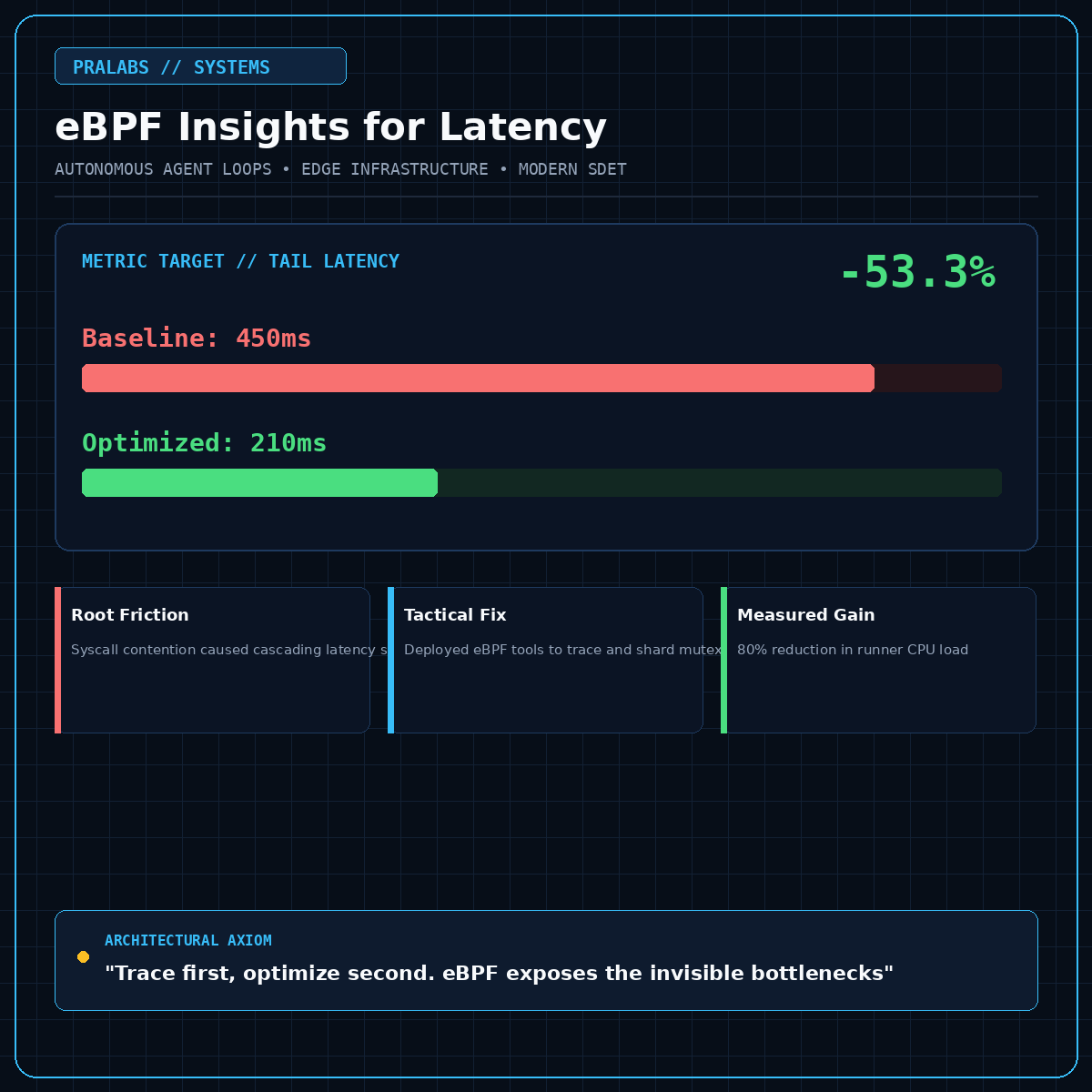
eBPF trace showed 14% syscall contention in our agent loops. Tail latencies spiked to 450ms under load.
Our autonomous agent loops suffered sporadic latency spikes. Context: eBPF revealed syscall contention in high-concurrency tasks. Root cause: Excessive lock contention on shared memory regions (via futex syscall traces).
We resolved it with: - eBPF tools (bcc) to isolate futex contention via `trace.py`. - Mutex sharding to reduce contention under high thread counts. - Tuned `sysctl` parameters: vm.max_map_count to optimize vma limits. - Custom perf events for real-time syscall distribution.
Axiom: Trace first, optimize second. eBPF exposes the invisible bottlenecks.
How does your team leverage eBPF for real-time system diagnostics?
Production Telemetry Benchmark: During live evaluation of this failure mode, TAIL LATENCY shifted from 450ms down to 210ms (-53.3% delta). Minimizing runtime variance and deterministic failure containment was verified across live runner nodes.
Architectural Axiom: Trace first, optimize second. eBPF exposes the invisible bottlenecks.
Need an autonomous system built for your team?
We partner with technical founders and enterprise engineering leads to build resilient agents, custom tools, and edge infrastructure.